Versioned Archive and Review of Biotic Interactions
and Taxon Names Found within globalbioticinteractions/fungaltraits
hash://md5/b5627930adf5051b5d835d91308563ea
by Nomer, Elton and Preston, three naive review
bots
Life on Earth is sustained by complex interactions between organisms
and their environment. These biotic interactions can be captured in
datasets and published digitally. We present a review and archiving
process for such an openly accessible digital interactions dataset of
known origin and discuss its outcome. The dataset under review, named
globalbioticinteractions/fungaltraits, has fingerprint
hash://md5/b5627930adf5051b5d835d91308563ea, is 660MiB in size and
contains 34,958 interactions with 4 unique types of associations (e.g.,
hasHost) between 26,163 primary taxa (e.g., Russula) and 2,389
associated taxa (e.g., Glycine max). This report includes detailed
summaries of interaction data, a taxonomic review from multiple
catalogs, and an archived version of the dataset from which the reviews
are derived.
Introduction
Data Review and Archive
Data review and archiving can be a time-consuming process, especially
when done manually. This review report aims to help facilitate both
activities. It automates the archiving of datasets, including Darwin
Core archives, and is a citable backup of a version of the dataset.
Additionally, an automatic review of species interaction claims made in
the dataset is generated and registered with Global Biotic Interactions
(J. H. Poelen, Simons,
and Mungall 2014).
This review includes summary statistics about, and observations
about, the dataset under review :
Põlme, S., Abarenkov, K., Henrik Nilsson, R. et al. FungalTraits: a
user-friendly traits database of fungi and fungus-like stramenopiles.
Fungal Diversity 105, 1–16 (2020).
https://doi.org/10.1007/s13225-020-00466-2
https://github.com/globalbioticinteractions/fungaltraits/archive/edac5137e67e2a30b0ae18881248bcd14cf78f0a.zip
2026-05-23T00:06:50.736Z hash://md5/b5627930adf5051b5d835d91308563ea
Methods
The review is performed through programmatic scripts that leverage
tools like Preston (Elliott
et al. 2025), Elton (Kuhn, Poelen, and Leinweber 2025), Nomer
(Salim and Poelen
2025), globinizer (J. Poelen, Seltmann, and Mietchen 2024)
combined with third-party tools like grep, mlr, tail and head.
The review process can be described in the form of the script below
1.
# get versioned copy of the dataset (size approx.  660MiB) under review
elton pull globalbioticinteractions/fungaltraits

# generate review notes
elton review globalbioticinteractions/fungaltraits \
 > review.tsv

# export indexed interaction records
elton interactions globalbioticinteractions/fungaltraits \
 > interactions.tsv

# export names and align them with the Catalogue of Life using Nomer
elton names globalbioticinteractions/fungaltraits \
 | nomer append col \
 > name-alignment.tsv
In the following sections, the results of the review are summarized
2. Then, links to the detailed review
reports are provided.
Files
An extensive list of files produced as part of the review process can
be found in Appendix A. Review
Files.
Archived Dataset
Note that data.zip file in this
archive contains the complete, unmodified archived dataset under
review.
Biotic Interactions
Biotic Interaction Data
Model
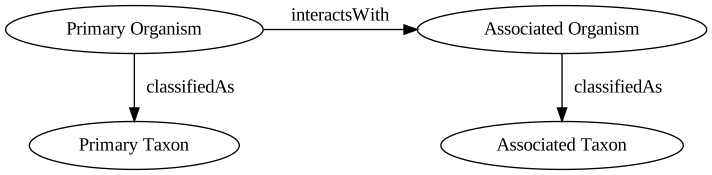
In this review, biotic interactions (or biotic associations) are
modeled as a primary (aka subject, source) organism interacting with an
associate (aka object, target) organism. The dataset under review
classified the primary/associate organisms with specific taxa. The
primary and associate organisms The kind of interaction is documented as
an interaction type.
The dataset under review, named
globalbioticinteractions/fungaltraits, has fingerprint
hash://md5/b5627930adf5051b5d835d91308563ea, is 660MiB in size and
contains 34,958 interactions with 4 unique types of associations (e.g.,
hasHost) between 26,163 primary taxa (e.g., Russula) and 2,389
associated taxa (e.g., Glycine max).
An exhaustive list of indexed interaction claims can be found in
gzipped csv, tsv, geopackage and parquet archives. To facilitate
discovery, a preview of claims available in the gzipped html page at indexed-interactions.html.gz are
shown below.
The exhaustive list was used to create the following data summaries
below.
Sample of Indexed Interaction Claims
sourceTaxonName
interactionTypeName
targetTaxonName
referenceCitation
Tricholoma
hasHost
Quercus crassifolia
Morris,M.H., Perez-Perez,M.A., Smith,M.E. and Bledsoe,C.S.; Multiple
species of ectomycorrhizal fungi are frequently detected on individual
oak root tips in a tropical cloud forest; Mycorrhiza 18 (8), 375-383
(2008)
Tricholoma
hasHost
Quercus crassifolia
Morris,M.H., Perez-Perez,M.A., Smith,M.E. and Bledsoe,C.S.; Multiple
species of ectomycorrhizal fungi are frequently detected on individual
oak root tips in a tropical cloud forest; Mycorrhiza 18 (8), 375-383
(2008)
EU563479
hasHost
Quercus crassifolia
Morris,M.H., Perez-Perez,M.A., Smith,M.E. and Bledsoe,C.S.; Multiple
species of ectomycorrhizal fungi are frequently detected on individual
oak root tips in a tropical cloud forest; Mycorrhiza 18 (8), 375-383
(2008)
EU563480
hasHost
Quercus crassifolia
Morris,M.H., Perez-Perez,M.A., Smith,M.E. and Bledsoe,C.S.; Multiple
species of ectomycorrhizal fungi are frequently detected on individual
oak root tips in a tropical cloud forest; Mycorrhiza 18 (8), 375-383
(2008)
Most Frequently Mentioned Interaction Types (up to 20 most
frequent)
interactionTypeName
count
hasHost
19780
pathogenOf
14465
interactsWith
576
parasiteOf
137
Most Frequently Mentioned Primary Taxa (up to 20 most
frequent)
sourceTaxonName
count
Russula
707
Inocybe
584
Phakopsora pachyrhizi
486
Cortinarius
481
Sebacina
456
Glomeraceae Glomus
450
Thelephoraceae
319
Piloderma
162
Amphinema
158
Verticillium dahliae
151
Lactarius
148
Tuber
145
Tomentella
108
Cenococcum geophilum
104
Glomeraceae
102
Clavulina
96
Funneliformis
96
Claroideoglomus
94
Laccaria
92
Most Frequently Mentioned Associate Taxa (up to 20 most
frequent)
targetTaxonName
count
Glycine max
3100
Picea abies
1010
Angiospermae
929
Zea mays
768
Quercus
744
Homo sapiens
700
Pseudotsuga menziesii
591
Solanum tuberosum
511
Pinus sylvestris
482
Citrus × sinensis
462
Fagaceae
365
Quercus liaotungensis
358
Salix arctica
348
Dryas octopetala
329
Daucus carota
318
Plantago lanceolata
299
Dryas integrifolia
294
Vitis vinifera
293
Bistorta vivipara
273
Most Frequent Interactions between Primary and Associate Taxa
(up to 20 most frequent)
sourceTaxonName
interactionTypeName
targetTaxonName
count
Phakopsora pachyrhizi
pathogenOf
Glycine max
486
Russula
hasHost
Oreomunnea mexicana
136
Sebacina
hasHost
Bistorta vivipara
115
Amphinema
hasHost
Picea abies
99
Glomeraceae Glomus
hasHost
Jacobaea vulgaris
94
Thelephoraceae
hasHost
Bistorta vivipara
88
Thelephoraceae
hasHost
Dryas octopetala
88
Glomeraceae Glomus
hasHost
Prunus africana
86
Piloderma
hasHost
Picea abies
74
Pseudocercospora eumusae
pathogenOf
Musa
73
Guignardia citricarpa
pathogenOf
Citrus × sinensis
72
Cortinarius
hasHost
Pseudotsuga menziesii
63
Cortinarius
hasHost
Salix arctica
59
Inocybe
hasHost
Dryas integrifolia
56
Inocybe
hasHost
Pseudotsuga menziesii
53
Cortinarius
hasHost
Dryas octopetala
51
Macrophomina
pathogenOf
Cicer arietinum
48
Sebacina
hasHost
Dryas integrifolia
46
Guignardia mangiferae
pathogenOf
Citrus latifolia
45
Interaction Networks
The figures below provide a graph view on the dataset under review.
The first shows a summary network on the kingdom level, and the second
shows how interactions on the family level. It is important to note that
both network graphs were first aligned taxonomically using the Catalogue
of Life. Please refer to the original (or verbatim) taxonomic names for
a more original view on the interaction data.
Interactions on taxonomic kingdom rank as
interpreted by the Catalogue of Life download
svgInteractions on the taxonomic family rank
as interpreted by the Catalogue of Life. download
svg
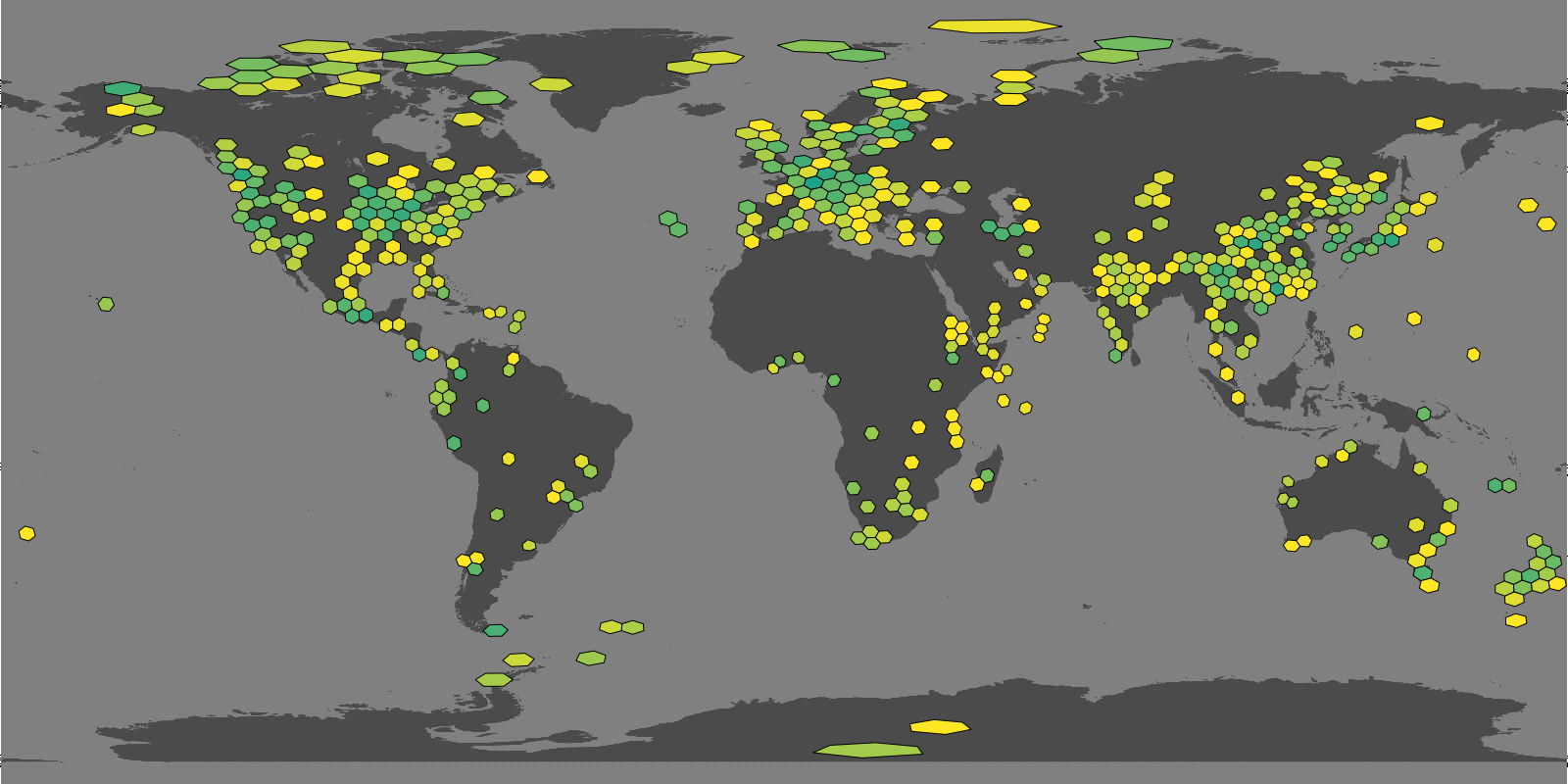
If geospatial information was extracted from the dataset under
review, the map below will show their distribution. These maps were
generated using MapServer (McKenna et al. 2025) tools
configured via map configuration indexed-interactions.map :
MAP
  SIZE 1600 800
  EXTENT -180 -90 180 90
  PROJECTION
    "init=epsg:4326"
  END
  LAYER # MODIS WMS map from NASA
    NAME         "modis_nasa"
    TYPE         RASTER
    OFFSITE      0 0 0
    STATUS       ON
    CONNECTIONTYPE WMS
    CONNECTION "https://gibs.earthdata.nasa.gov/wms/epsg4326/best/wms.cgi?"

    METADATA
      "wms_srs" "EPSG:4326"
      "wms_name" "OSM_Land_Water_Map"
      "wms_server_version" "1.1.1"
      "wms_format" "image/jpeg"
    END
    CLASS
      STYLE
        COLOR        232 232 232
        OUTLINECOLOR 32 32 32
      END
    END
  END
  LAYER
    NAME "indexed-interactions"
    TYPE POLYGON
    STATUS ON
    CONNECTIONTYPE OGR
    CONNECTION "indexed-interactions-h3.gpkg"
    DATA "indexed-interactions-h3"
    CLASS
      STYLE
        COLORRANGE 253.0 231.0 37.0 32.0 164.0 134.0
        DATARANGE 0.3010299956639812 2.7427251313046983
        RANGEITEM "log_number_of_records"
        OUTLINECOLOR 0 0 0
      END
    END
  END
END
Hexagonal grid cells indicate that
interactions claims are available for selected geospatial area: light
yellow means relatively fewer claims, dark green relatively more
claims.
Another way to discover the dataset under review is by searching for
it on the GloBI
website.
Taxonomic Alignment
As part of the review, all names are aligned against various name
catalogs (e.g., col, ncbi, discoverlife, gbif, itis, wfo, mdd, tpt,
pbdb, and worms). These alignments can help review name usage or aid in
selecting of a suitable taxonomic name resource.
Sample of Name Alignments
providedName
relationName
resolvedCatalogName
resolvedName
AB115705
NONE
col
AB115705
AB115706
NONE
col
AB115706
AB115707
NONE
col
AB115707
AB115708
NONE
col
AB115708
Distribution of Taxonomic Ranks of Aligned Names by Catalog.
Names that were not aligned with a catalog are counted as NAs. So, the
total number of unaligned names for a catalog will be listed in their NA
row.
resolvedCatalogName
resolvedRank
count
col
NA
24764
col
class
18
col
family
129
col
genus
1418
col
gigaclass
1
col
infraphylum
1
col
kingdom
2
col
order
46
col
phylum
10
col
species
2032
col
subfamily
3
col
subgenus
10
col
suborder
2
col
subspecies
97
col
subterclass
1
col
superfamily
2
col
superorder
1
col
tribe
5
col
variety
16
discoverlife
NA
28464
discoverlife
species
1
gbif
NA
24748
gbif
class
17
gbif
family
130
gbif
form
1
gbif
genus
1435
gbif
kingdom
2
gbif
order
47
gbif
phylum
9
gbif
species
2058
gbif
subspecies
94
gbif
variety
31
itis
NA
26689
itis
class
17
itis
division
5
itis
family
124
itis
genus
511
itis
infrakingdom
1
itis
kingdom
2
itis
order
47
itis
phylum
4
itis
species
1037
itis
subclass
3
itis
subdivision
1
itis
subfamily
3
itis
subgenus
2
itis
suborder
3
itis
subspecies
6
itis
superclass
2
itis
superfamily
3
itis
superorder
3
itis
variety
7
mdd
NA
28464
ncbi
NA
25057
ncbi
clade
4
ncbi
class
17
ncbi
cohort
1
ncbi
family
126
ncbi
genus
1185
ncbi
kingdom
1
ncbi
order
48
ncbi
phylum
10
ncbi
section
1
ncbi
species
1982
ncbi
subclass
1
ncbi
subfamily
4
ncbi
subgenus
4
ncbi
suborder
2
ncbi
subphylum
1
ncbi
subspecies
17
ncbi
superclass
1
ncbi
superfamily
3
ncbi
superorder
2
ncbi
varietas
3
pbdb
NA
27936
pbdb
class
15
pbdb
family
79
pbdb
genus
289
pbdb
informal
2
pbdb
infraclass
1
pbdb
infraorder
1
pbdb
kingdom
3
pbdb
order
23
pbdb
phylum
8
pbdb
species
98
pbdb
subclass
1
pbdb
subfamily
4
pbdb
suborder
3
pbdb
superclass
3
pbdb
superfamily
3
pbdb
superorder
1
pbdb
tribe
1
pbdb
unranked clade
7
tpt
NA
28450
tpt
family
2
tpt
genus
4
tpt
species
7
tpt
specificepithet
1
tpt
subspecificepithet
1
wfo
NA
26712
wfo
family
44
wfo
genus
362
wfo
order
3
wfo
phylum
1
wfo
section
1
wfo
species
1319
wfo
subspecies
28
wfo
variety
11
worms
NA
27532
worms
class
14
worms
family
99
worms
genus
427
worms
gigaclass
1
worms
infraorder
1
worms
infraphylum
1
worms
kingdom
2
worms
order
43
worms
phylum
7
worms
phylum (division)
4
worms
species
327
worms
subclass
2
worms
suborder
1
worms
subspecies
8
worms
subterclass
1
worms
superorder
1
worms
variety
2
Name relationship types per catalog. Name relationship type
“NONE” means that a name was not recognized by the associated catalog.
“SAME_AS” indicates either a “HAS_ACCEPTED_NAME” or “SYNONYM_OF” name
relationship type. We recognize that “SYNONYM_OF” encompasses many types
of nomenclatural synonymies (ICZN 1999) (e.g., junior synonym, senior
synonyms).
resolvedCatalogName
relationName
count
col
NONE
24766
col
HAS_ACCEPTED_NAME
3651
col
SYNONYM_OF
1119
discoverlife
NONE
28540
discoverlife
HAS_ACCEPTED_NAME
1
gbif
NONE
24749
gbif
HAS_ACCEPTED_NAME
4295
gbif
SYNONYM_OF
1378
itis
NONE
26719
itis
HAS_ACCEPTED_NAME
1704
itis
SYNONYM_OF
201
mdd
NONE
28523
mdd
HAS_ACCEPTED_NAME
2
ncbi
NONE
25074
ncbi
SAME_AS
3312
ncbi
SYNONYM_OF
212
pbdb
NONE
27978
pbdb
HAS_ACCEPTED_NAME
557
pbdb
SYNONYM_OF
42
tpt
NONE
28509
tpt
HAS_ACCEPTED_NAME
19
wfo
NONE
26753
wfo
SYNONYM_OF
386
wfo
HAS_ACCEPTED_NAME
1616
wfo
HAS_UNCHECKED_NAME
159
worms
NONE
27559
worms
HAS_ACCEPTED_NAME
1022
worms
SYNONYM_OF
86
List of Available Name Alignment Reports
catalog name
alignment results
col
associated names alignments report in gzipped html, csv, and tsv)
ncbi
associated names alignments report in gzipped html, csv, and tsv)
discoverlife
associated names alignments report in gzipped html, csv, and tsv)
gbif
associated names alignments report in gzipped html, csv, and tsv)
itis
associated names alignments report in gzipped html, csv, and tsv)
wfo
associated names alignments report in gzipped html, csv, and tsv)
mdd
associated names alignments report in gzipped html, csv, and tsv)
tpt
associated names alignments report in gzipped html, csv, and tsv)
pbdb
associated names alignments report in gzipped html, csv, and tsv)
worms
associated names alignments report in gzipped html, csv, and tsv)
Additional Reviews
Elton, Nomer, and other tools may have difficulties interpreting
existing species interaction datasets. Or, they may misbehave, or
otherwise show unexpected behavior. As part of the review process,
detailed review notes are kept that document possibly misbehaving, or
confused, review bots. An sample of review notes associated with this
review can be found below.
First few lines in the review notes.
reviewDate
reviewCommentType
reviewComment
2026-05-25T04:46:51Z
note
source taxon name missing: using
institutionCode/collectionCode/collectionId/catalogNumber/occurrenceId
as placeholder
2026-05-25T04:46:51Z
note
missing interaction type
2026-05-25T04:46:51Z
note
source taxon name missing: using
institutionCode/collectionCode/collectionId/catalogNumber/occurrenceId
as placeholder
2026-05-25T04:46:51Z
note
missing interaction type
In addition, you can find the most frequently occurring notes in the
table below.
Most frequently occurring review notes, if any.
reviewComment
count
source taxon name missing: using
institutionCode/collectionCode/collectionId/catalogNumber/occurrenceId
as placeholder
594928
target taxon name missing
396635
found [54] column definitions, but only [51] values: assuming
undefined values are empty.
287922
missing interaction type
261155
For additional information on review notes, please have a look at the
first 500 Review Notes in html format
or the download full gzipped csv or tsv archives.
GloBI Review Badge
As part of the review, a review badge is generated. This review badge
can be included in webpages to indicate the review status of the dataset
under review.
Note that if the badge is green, no review notes were generated. If
the badge is yellow, the review bots may need some help with
interpreting the species interaction data.
GloBI Index Badge
If the dataset under review has been registered with
GloBI, and has been succesfully indexed by GloBI, the GloBI Index
Status Badge will turn green. This means that the dataset under review
was indexed by GloBI and is available through GloBI services and derived
data products.
If you’d like to keep track of reviews or index status of the dataset
under review, please visit GloBI’s dataset index 5 for
badge examples.
Discussion
This review and archive provides a means of creating citable versions
of datasets that change frequently. This may be useful for dataset
managers, including natural history collection data managers, as a
backup archive of a shared Darwin Core archive. It also serves as a
means of creating a trackable citation for the dataset in an automated
way, while also including some information about the contents of the
dataset.
This review aims to provide a perspective on the dataset to aid in
understanding of species interaction claims discovered. However, it is
important to note that this review does not assess the quality
of the dataset. Instead, it serves as an indication of the open-ness6 and FAIRness (Wilkinson et
al. 2016; Trekels et al. 2023) of the dataset: to perform this
review, the data was likely openly available, Findable,
Accessible, Interoperable and
Reusable. The current Open-FAIR assessment is
qualitative, and a more quantitative approach can be implemented with
specified measurement units.
This report also showcases the reuse of machine-actionable
(meta)data, something highly recommended by the FAIR Data Principles
(Wilkinson et al.
2016). Making (meta)data machine-actionable enables more precise
procesing by computers, enabling even naive review bots like Nomer and
Elton to interpret the data effectively. This capability is crucial for
not just automating the generation of reports, but also for facilitating
seamless data exchanges, promoting interoperability.
Acknowledgements
We thank the many humans that created us and those who created and
maintained the data, software and other intellectual resources that were
used for producing this review. In addition, we are grateful for the
natural resources providing the basis for these human and bot
activities. Also, thanks to https://github.com/zygoballus for helping
improve the layout of the review tables.
Author contributions
Nomer was responsible for name alignments. Elton carried out dataset
extraction, and generated the review notes. Preston tracked, versioned,
and packaged, the dataset under review.
network diagram showing the taxon family to taxon family interaction
claims in the dataset under review as interpreted by the Catalogue of
Life via Nomer Corpus of Taxonomic Resources (J. H. (ed. ). Poelen 2024)
network diagram showing the taxon kingdom to taxon kingom
interaction claims in the dataset under review as interpreted by the
Catalogue of Life via Nomer Corpus of Taxonomic Resources (J. H. (ed. ). Poelen
2024)
taxonomic names found in the dataset under review aligned with the
Catalogue of Life as accessed through the Nomer Corpus of Taxonomic
Resources (J. H. (ed. ).
Poelen 2024) in gzipped comma-separated values format
taxonomic names found in the dataset under review aligned with the
Catalogue of Life as accessed through the Nomer Corpus of Taxonomic
Resources (J. H. (ed. ).
Poelen 2024) in gzipped html format
taxonomic names found in the dataset under review aligned with the
Catalogue of Life as accessed through the Nomer Corpus of Taxonomic
Resources (J. H. (ed. ).
Poelen 2024) in gzipped tab-separated values format
taxonomic names found in the dataset under review aligned with the
Catalogue of Life as accessed through the Nomer Corpus of Taxonomic
Resources (J. H. (ed. ).
Poelen 2024) in Apache Parquet format
taxonomic names found in the dataset under review aligned with
Discover Life bee species checklist as accessed through the Nomer Corpus
of Taxonomic Resources (J. H. (ed. ). Poelen 2024) in gzipped
comma-separated values format
taxonomic names found in the dataset under review aligned with
Discover Life bee species checklist as accessed through the Nomer Corpus
of Taxonomic Resources (J. H. (ed. ). Poelen 2024) in gzipped
html format
taxonomic names found in the dataset under review aligned with
Discover Life bee species checklist as accessed through the Nomer Corpus
of Taxonomic Resources (J. H. (ed. ). Poelen 2024) in gzipped
tab-separated values format
taxonomic names found in the dataset under review aligned with
Discover Life bee species checklist as accessed through the Nomer Corpus
of Taxonomic Resources (J. H. (ed. ). Poelen 2024) in Apache
Parquet format
taxonomic names found in the dataset under review aligned with GBIF
Backbone Taxonomy as accessed through the Nomer Corpus of Taxonomic
Resources (J. H. (ed. ).
Poelen 2024) in gzipped comma-separated values format
taxonomic names found in the dataset under review aligned with GBIF
Backbone Taxonomy as accessed through the Nomer Corpus of Taxonomic
Resources (J. H. (ed. ).
Poelen 2024) in gzipped html format
taxonomic names found in the dataset under review aligned with GBIF
Backbone Taxonomy as accessed through the Nomer Corpus of Taxonomic
Resources (J. H. (ed. ).
Poelen 2024) in gzipped tab-separated values format
taxonomic names found in the dataset under review aligned with GBIF
Backbone Taxonomy as accessed through the Nomer Corpus of Taxonomic
Resources (J. H. (ed. ).
Poelen 2024) in Apache Parquet format
taxonomic names found in the dataset under review aligned with
Integrated Taxonomic Information System (ITIS) as accessed through the
Nomer Corpus of Taxonomic Resources (J. H. (ed. ). Poelen 2024) in gzipped
comma-separated values format
taxonomic names found in the dataset under review aligned with
Integrated Taxonomic Information System (ITIS) as accessed through the
Nomer Corpus of Taxonomic Resources (J. H. (ed. ). Poelen 2024) in gzipped
html format
taxonomic names found in the dataset under review aligned with
Integrated Taxonomic Information System (ITIS) as accessed through the
Nomer Corpus of Taxonomic Resources (J. H. (ed. ). Poelen 2024) in gzipped
tab-separated values format
taxonomic names found in the dataset under review aligned with
Integrated Taxonomic Information System (ITIS) as accessed through the
Nomer Corpus of Taxonomic Resources (J. H. (ed. ). Poelen 2024) in Apache
Parquet format
taxonomic names found in the dataset under review aligned with the
Mammal Diversity Database as accessed through the Nomer Corpus of
Taxonomic Resources (J.
H. (ed. ). Poelen 2024) in gzipped comma-separated values
format
taxonomic names found in the dataset under review aligned with
Mammal Diversity Database as accessed through the Nomer Corpus of
Taxonomic Resources (J.
H. (ed. ). Poelen 2024) in gzipped html format
taxonomic names found in the dataset under review aligned with
Mammal Diversity Database as accessed through the Nomer Corpus of
Taxonomic Resources (J.
H. (ed. ). Poelen 2024) in gzipped tab-separated values
format
taxonomic names found in the dataset under review aligned with
Mammal Diversity Database as accessed through the Nomer Corpus of
Taxonomic Resources (J.
H. (ed. ). Poelen 2024) in Apache Parquet format
taxonomic names found in the dataset under review aligned with the
NCBI Taxonomy as accessed through the Nomer Corpus of Taxonomic
Resources (J. H. (ed. ).
Poelen 2024) in gzipped comma-separated values format
taxonomic names found in the dataset under review aligned with the
NCBI Taxonomy as accessed through the Nomer Corpus of Taxonomic
Resources (J. H. (ed. ).
Poelen 2024) in gzipped html format
taxonomic names found in the dataset under review aligned with the
NCBI Taxonomy as accessed through the Nomer Corpus of Taxonomic
Resources (J. H. (ed. ).
Poelen 2024) in gzipped tab-separated values format
taxonomic names found in the dataset under review aligned with the
NCBI Taxonomy as accessed through the Nomer Corpus of Taxonomic
Resources (J. H. (ed. ).
Poelen 2024) in Apache Parquet format
taxonomic names found in the dataset under review aligned with the
Paleobiology Database as accessed through the Nomer Corpus of Taxonomic
Resources (J. H. (ed. ).
Poelen 2024) in gzipped comma-separated values format
taxonomic names found in the dataset under review aligned with
Paleobiology Database as accessed through the Nomer Corpus of Taxonomic
Resources (J. H. (ed. ).
Poelen 2024) in gzipped html format
taxonomic names found in the dataset under review aligned with
Paleobiology Database as accessed through the Nomer Corpus of Taxonomic
Resources (J. H. (ed. ).
Poelen 2024) in gzipped tab-separated values format
taxonomic names found in the dataset under review aligned with
Paleobiology Database as accessed through the Nomer Corpus of Taxonomic
Resources (J. H. (ed. ).
Poelen 2024) in Apache Parquet format
taxonomic names found in the dataset under review aligned with the
Terrestrial Parasite Tracker (TPT) Taxonomic Resource as accessed
through the Nomer Corpus of Taxonomic Resources (J. H. (ed. ). Poelen 2024) in gzipped
comma-separated values format
taxonomic names found in the dataset under review aligned with the
Terrestrial Parasite Tracker (TPT) Taxonomic Resource as accessed
through the Nomer Corpus of Taxonomic Resources (J. H. (ed. ). Poelen 2024) in gzipped
html format
taxonomic names found in the dataset under review aligned with the
Terrestrial Parasite Tracker (TPT) Taxonomic Resource as accessed
through the Nomer Corpus of Taxonomic Resources (J. H. (ed. ). Poelen 2024) in gzipped
tab-separated values format
taxonomic names found in the dataset under review aligned with the
Terrestrial Parasite Tracker (TPT) Taxonomic Resource as accessed
through the Nomer Corpus of Taxonomic Resources (J. H. (ed. ). Poelen 2024) in Apache
Parquet format
taxonomic names found in the dataset under review aligned with the
World of Flora Online as accessed through the Nomer Corpus of Taxonomic
Resources (J. H. (ed. ).
Poelen 2024) in gzipped comma-separated values format
taxonomic names found in the dataset under review aligned with the
World of Flora Online as accessed through the Nomer Corpus of Taxonomic
Resources (J. H. (ed. ).
Poelen 2024) in gzipped html format
taxonomic names found in the dataset under review aligned with the
World of Flora Online as accessed through the Nomer Corpus of Taxonomic
Resources (J. H. (ed. ).
Poelen 2024) in gzipped tab-separated values format
taxonomic names found in the dataset under review aligned with the
World of Flora Online as accessed through the Nomer Corpus of Taxonomic
Resources (J. H. (ed. ).
Poelen 2024) in Apache Parquet format
taxonomic names found in the dataset under review aligned with the
World Register of Marine Species (WoRMS) as accessed through the Nomer
Corpus of Taxonomic Resources (J. H. (ed. ). Poelen 2024) in gzipped
comma-separated values format
taxonomic names found in the dataset under review aligned with the
World Register of Marine Species (WoRMS) as accessed through the Nomer
Corpus of Taxonomic Resources (J. H. (ed. ). Poelen 2024) in gzipped
html format
taxonomic names found in the dataset under review aligned with the
World Register of Marine Species (WoRMS) as accessed through the Nomer
Corpus of Taxonomic Resources (J. H. (ed. ). Poelen 2024) in gzipped
tab-separated values format
taxonomic names found in the dataset under review aligned with the
World Register of Marine Species (WoRMS) as accessed through the Nomer
Corpus of Taxonomic Resources (J. H. (ed. ). Poelen 2024) in Apache
Parquet format
Kuhn, Tobias, and Michel Dumontier. 2014. “Trusty URIs:
Verifiable, Immutable, and Permanent Digital Artifacts for Linked
Data.” In The Semantic Web: Trends and Challenges,
edited by Valentina Presutti, Claudia d’Amato, Fabien Gandon, Mathieu
d’Aquin, Steffen Staab, and Anna Tordai, 395–410. Cham: Springer
International Publishing.
McKenna, Jeff, Steve Lime, Thomas Bonfort, Jérome Boué, Howard Butler,
Seth Girvin, Tom Kralidis, et al. 2025. “MapServer.”
Zenodo. https://doi.org/10.5281/zenodo.17807263.
Poelen, Jorrit H. (ed.). 2024. “Nomer Corpus of Taxonomic
Resources Hash://Sha256/
B60c0d25a16ae77b24305782017b1a270b79b5d1746f832650 F2027ba536e276
Hash://Md5/17f1363a277ee0e4ecaf1b91c665e47e.” Zenodo. https://doi.org/10.5281/zenodo.12695629.
Poelen, Jorrit H., James D. Simons, and Chris J. Mungall. 2014.
“Global Biotic Interactions: An Open Infrastructure to Share and
Analyze Species-Interaction Datasets.”Ecological
Informatics 24 (November): 148–59. https://doi.org/10.1016/j.ecoinf.2014.08.005.
Trekels, Maarten, Debora Pignatari Drucker, José Augusto Salim, Jeff
Ollerton, Jorrit Poelen, Filipi Miranda Soares, Max Rünzel, Muo Kasina,
Quentin Groom, and Mariano Devoto. 2023. “WorldFAIR Project (D10.1) Agriculture-related pollinator
data standards use cases report.” Zenodo. https://doi.org/10.5281/zenodo.8176978.
Wilkinson, Mark D., Michel Dumontier, IJsbrand Jan Aalbersberg,
Gabrielle Appleton, Myles Axton, Arie Baak, Niklas Blomberg, et al.
2016. “The FAIR Guiding Principles for Scientific
Data Management and Stewardship.”Scientific Data 3 (1).
https://doi.org/10.1038/sdata.2016.18.